On this page
Radiant system losing pressure?
Floor loops show up clearly on thermal cameras. Call to reach a provider.
(813) 303-9621Free call connection · Open 24/7 · Plant City, Brandon, Valrico, Seffner & DoverHydronic and radiant floor leak detection finds leaks in closed-loop heating systems where warm water circulates through PEX tubing embedded in a slab or under flooring, or through baseboard and panel radiators. Providers watch system pressure, isolate zones at the manifold, and use infrared thermal imaging, which shows the warm loop pattern in the floor, to pinpoint where water is escaping.
How Hydronic Systems Work
A hydronic system heats water with a boiler or water heater and pumps it through a closed loop of tubing. In radiant floors, that tubing, usually PEX, is laid in the slab or under the floor in loops that run back to a manifold, where each zone can be shut off. The system is filled once and kept at a low, steady pressure. It shouldn't need fresh water added regularly.
Radiant floors aren't common in Florida's climate, but they do appear in some custom homes, additions, bathrooms with heated tile, and some commercial spaces. Similar closed loops are used for snow-melt elsewhere and for chilled water in commercial cooling.
Signs of a Hydronic Leak
- System pressure gauge dropping over days or weeks
- The automatic fill valve adding water often
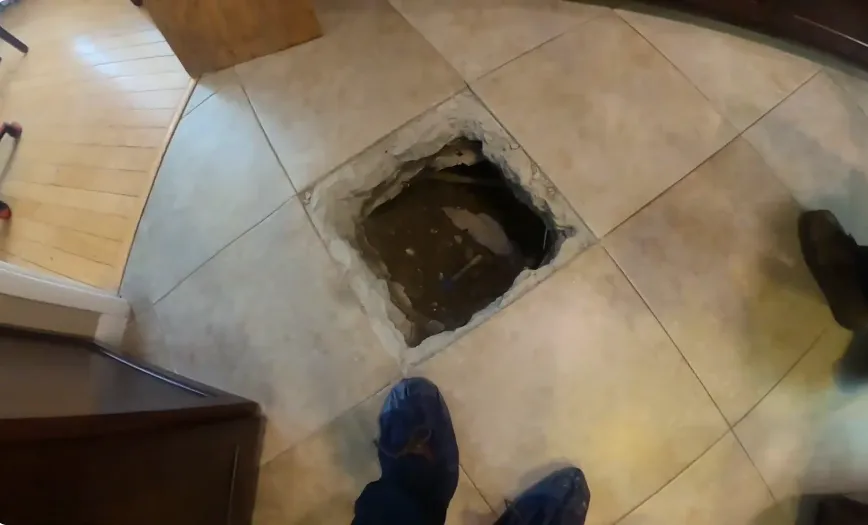
- Damp spots or staining on floors over the loops
- Cold zones that used to heat evenly
- Air in the system, gurgling or noisy circulation
- Drips at the manifold, boiler or pump fittings
How Are Radiant Floor Leaks Found?
- Pressure watch: the fill valve is closed and the system pressure watched to confirm a leak.
- Zone isolation: each loop is shut off at the manifold in turn to find the leaking zone.
- Thermal imaging: with warm water running through the zone, an infrared camera shows the tubing pattern and a hot bloom or irregularity where water escapes. See infrared thermal imaging.
- Acoustic and tracer methods confirm the spot when thermal readings are unclear.
- Manifold and boiler check for leaks at fittings, valves and the pump.
Pro tip: Note the system pressure on the gauge when everything is working well. That baseline makes it easy to spot a slow loss later.
Why Do Radiant Loops Leak?
Embedded PEX tubing is durable, so leaks often trace back to damage from drilling or fasteners during later renovations, a fitting under the floor, or failures at the manifold. Slab movement in sandy soil can stress tubing where it enters or leaves the slab. Water chemistry and missing inhibitors can corrode boiler and pump components.
Hydronic Loop or Domestic Water Leak?
Because radiant tubing and drinking water lines can share the same slab, it helps to know which one is leaking before anyone starts opening the floor. The domestic water system is connected to the meter (or a well), so a supply leak moves the meter with all fixtures off. The hydronic loop is closed. It shows its leak as falling pressure on the boiler gauge and a fill valve that keeps adding water, while the meter stays steady unless that fill valve is open. Closing the hydronic fill valve and watching both gauges for a few hours usually tells you which system to focus on.
After the Leak Is Found
Leaks at the manifold or boiler are usually straightforward fixes. A leak in embedded tubing is repaired by opening the floor over the marked spot and splicing the tube, or by abandoning that loop if a repair isn't practical. Call (813) 303-9621 for a free quote, available for leak detection across Plant City, or read about slab leak detection for supply lines in the same slab.
Warning: Don't drill or fasten into a floor with radiant heating without knowing where the loops run. A thermal scan can map them first.
Hydronic & Radiant Floor Leak Detection FAQs
How do I know if my radiant floor is leaking?
The system pressure drops over time, the fill valve adds water often, or zones heat unevenly. Damp spots on the floor are another sign.
Can a radiant floor leak be found without breaking the floor?
Yes. Thermal imaging shows the tubing pattern and the leak, so only a small area needs to be opened for repair.
Are radiant floors common in Plant City?
They're uncommon in Florida but do appear in some custom homes, heated bathroom floors and commercial spaces.
Is a hydronic leak the same as a slab leak?
Both can be under the slab, but a hydronic leak is in the closed heating loop, while a slab leak is in the drinking water supply line.
How do I get a quote for radiant floor leak detection?
Call (813) 303-9621 and describe your system. A local provider can give you a free quote.