On this page
- How Are Drain Leaks Different From Water Line Leaks?
- How Do Providers Test Drains and Sewer Lines?
- What Are the Signs of a Sewer or Drain Leak?
- What Causes Drain and Sewer Leaks in Plant City?
- What Can You Check Before Calling?
- What Happens During a Sewer and Drain Inspection?
- What Shapes a Drain Leak Search?
- When Is a Sewer Problem an Emergency?
- FAQs
Sewer smell or slow drains?
Call now to be connected with a provider for sewer and drain leak detection.
(813) 303-9621Free call connection · Open 24/7 · Plant City, Brandon, Valrico, Seffner & DoverSewer and drain leak detection finds cracks, separated joints, breaks and failed seals in the pipes that carry wastewater out of your home. Because drains aren't under constant pressure like supply lines, they're tested differently: a camera views the inside of the pipe, a hydrostatic test fills the drain system to see if it holds water, and a smoke test shows where sewer gas escapes.
How Are Drain Leaks Different From Water Line Leaks?
Your home has two plumbing systems. The supply side carries clean water in under pressure, so a break leaks all the time and moves the water meter. The drain-waste-vent (DWV) side carries used water out by gravity. A cracked drain only leaks when water flows down it: after a shower, a load of laundry, or a flush.
That difference matters. A drain leak under the slab won't show on a meter test, and it won't make the hissing sound acoustic equipment listens for. Instead, providers look inside the pipe with a camera, fill the system to see whether it holds, or push smoke through it to find openings. If your meter test shows a leak, the problem is on the supply side; see slab leak detection instead.
Drain leaks also carry wastewater, not clean water. Over time that can saturate soil under the slab, attract insects and create odors, which makes finding them just as important.
How Do Providers Test Drains and Sewer Lines?
Video camera inspection. A waterproof camera on a flexible push cable goes in through a cleanout, roof vent or fixture opening. It shows cracks, offset joints, bellies where water pools, roots, scale and collapsed sections in real time. A transmitter in the camera head lets the technician mark the exact location and depth from above. Details on our sewer camera inspection page.
Hydrostatic testing. The building drain is plugged at the cleanout, and the system under the slab is filled with water to just below floor level. If the water level drops over a set time, the drains under the slab are leaking. Testing sections separately narrows it down. See hydrostatic drain testing.
Smoke testing. Non-toxic smoke is blown into the drain and vent system. Wherever smoke appears, at a wall, a floor crack, a cabinet, the yard or a roof penetration, there's an opening letting sewer gas out.
Dye and flow testing. Running a specific fixture with dye helps confirm which drain is causing a stain or damp area.
What Are the Signs of a Sewer or Drain Leak?
- Sewer gas smell inside the home, especially near floors, cabinets or walls.
- Damp flooring or baseboards that appear after showers, baths or laundry, then dry out.
- Slow drains in several fixtures or gurgling sounds when toilets flush.
- Repeated clogs at the same spot even after cleaning.
- Insects such as roaches or drain flies gathering near a wall or floor.
- Soggy, lush or sunken patches along the sewer line path in the yard.
- Cracks in tile or slab near bathrooms or the kitchen.
- Sewage backing up into tubs or floor drains.
What Causes Drain and Sewer Leaks in Plant City?
Cast iron corrosion. Many homes built before the 1980s, including much of Historic Downtown Plant City, have cast iron drains. Cast iron rusts from the inside, and the bottom of the pipe can crack or wear through along its length.
Ground movement. Sandy soil that settles after heavy rain can shift drain lines under the slab and in the yard, separating joints and creating bellies.
Tree roots. Roots find tiny gaps at joints and grow inside, widening cracks and causing blockages.
Failed seals. Toilet wax rings, tub drain gaskets and slip joints under sinks can leak every time the fixture is used.
Installation issues. In newer homes, poorly glued PVC joints or lines damaged during construction can leak early.
Grease and buildup. Repeated clogs put pressure on weak spots and can force water out at joints.
What Can You Check Before Calling?
- Refill dry traps. Run water in unused sinks, tubs, showers and floor drains for a minute. A dry P-trap lets sewer gas in and is the simplest odor fix.
- Check the toilet base. A toilet that rocks, or moisture and odor at its base, points to a failed wax ring.
- Use one fixture at a time. Run a single shower or washer and watch whether a damp spot or odor appears nearby.
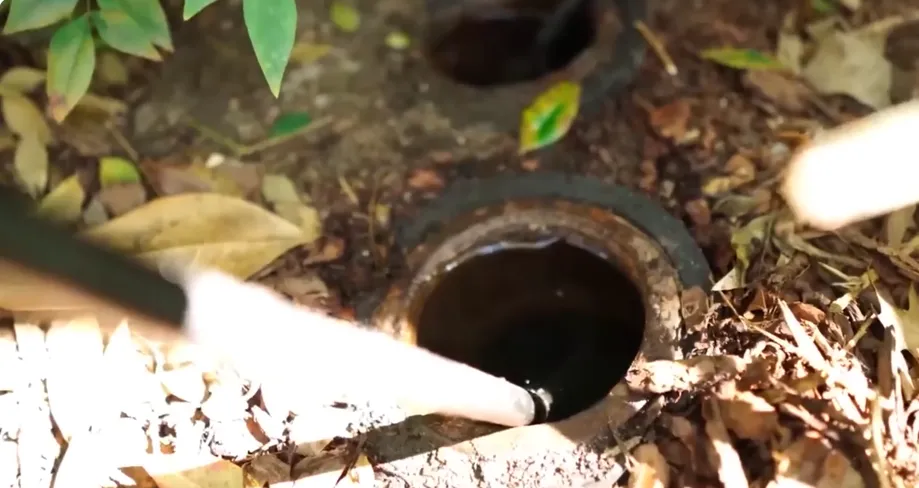
- Find your cleanout. It's usually a capped pipe near the house in the yard or by the driveway. Knowing where it is speeds up a camera inspection.
- Do a meter test to rule out a supply leak.
Pro tip: If you smell sewer gas only in one bathroom that rarely gets used, pour a little water down every drain in that room first. Dry traps cause more odor calls than broken pipes.
What Happens During a Sewer and Drain Inspection?
- Symptoms review and a check for supply leaks with a meter test.
- Camera inspection from the cleanout through the main line and branches, recorded for you to see.
- Locating any problem spots with the camera's transmitter and marking them on the floor or yard.
- Hydrostatic or smoke test if the camera alone doesn't explain the leak or odor.
- Findings and options: spot repair, pipe lining where suitable, or replacing a section. Many providers share the video.
What Shapes a Drain Leak Search?
| Factor | Why it matters |
|---|---|
| Cleanout access | An accessible cleanout makes camera work fast; no cleanout means entering through a toilet or roof vent. |
| Pipe material | Cast iron, clay and PVC fail in different ways and show differently on camera. |
| Under slab or yard | Under-slab drains may need hydrostatic testing; yard lines are often camera-only. |
| Number of branches | More bathrooms and kitchens mean more lines to inspect. |
| Blockages | Heavy clogs or roots may need clearing before the camera can pass. |
Call (813) 303-9621 for a free quote from a provider offering leak detection near Plant City.
When Is a Sewer Problem an Emergency?
Sewage backing up into tubs, showers or floor drains, or wastewater pooling inside, is urgent. Stop using water in the house, keep people and pets away from the contaminated water, and call. A strong, sudden sewer smell with gurgling drains is also worth a same-day call.
Warning: Sewage carries bacteria. Don't clean up a backup with bare hands, and keep children and pets out of affected areas until it's been properly cleaned and disinfected.
Sewer & Drain Leak Detection FAQs
What's the difference between a water line test and a sewer test?
A water line test pressurizes supply pipes to see if they hold. A sewer test uses a camera, fills the drain system with water (hydrostatic), or pushes smoke through it, because drains aren't normally under pressure.
Can a drain leak under the slab show on my water meter?
No. Drains carry water out by gravity, so a drain leak doesn't move the meter. If your meter moves with everything off, the leak is on the supply side.
What causes a sewer smell in the house?
Common causes are dry P-traps, failed toilet wax rings, cracked drain or vent pipes, and broken sewer lines. Smoke testing shows where the gas is escaping.
Is a camera inspection invasive?
No. The camera goes in through an existing cleanout, vent or fixture opening. Nothing is cut to perform the inspection.
Can tree roots cause sewer leaks?
Yes. Roots enter tiny gaps at pipe joints and grow, widening cracks and causing blockages that put more stress on the line.
How do I get a quote for sewer and drain leak detection?
Call (813) 303-9621 to be connected with a local provider who can give you a free quote based on your home and symptoms.