On this page
Pool line leaking?
Call now to be connected with a pool leak specialist for pressure testing.
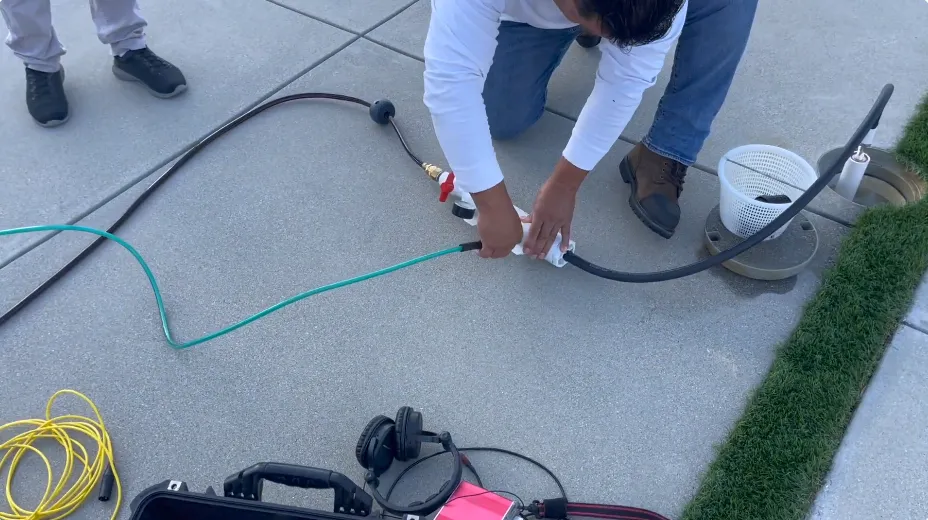
(813) 303-9621Free call connection · Open 24/7 · Plant City, Brandon, Valrico, Seffner & DoverPool plumbing pressure testing checks each underground pool line on its own. The line is plugged at the pool and at the equipment, filled with water, and brought to a controlled pressure while a gauge is watched. If the needle drops, that line is leaking. Air and water are then pushed through the failed line while the technician listens through the deck to find the break.
Why Pressure Test Pool Lines?
A pool has several buried pipes running between the pool and the equipment pad: skimmer lines, main drain lines, return lines, and often cleaner, spa and water feature lines. You can't see any of them, and they all lose water the same way, into the sand under the deck. Dye testing at the pool shows leaks in the shell and fittings, but it can't tell you which buried line is broken. Pressure testing can.
It's the step in pool leak detection that turns "the pool is losing water somewhere" into "the second return line is broken about eight feet from the equipment."
How Is a Pool Line Pressure Tested?
- Map the plumbing. The technician notes every line at the equipment pad and every opening in the pool, and photographs valve positions.
- Isolate. Lines that share a tee, such as a cleaner line teed off a return, are separated with plugs so each is tested alone.
- Plug both ends. Threaded or expansion plugs seal the line at the pool fitting and at the equipment.
- Fill and pressurize. Water is introduced through a test rig, then the line is brought to a controlled pressure.
- Watch the gauge. A line that holds is sound. A falling needle confirms a leak.
- Locate. Air and water pushed through the failed line escape at the break, making a bubbling or boiling sound that's picked up through the deck with a deck plate, ground microphone or soil probe.
Pro tip: If your pool loses more water with the pump running, mention it. That points to pressure-side return lines and helps the technician decide which lines to test first.
Which Lines Get Tested?
| Line | Side | What a leak looks like |
|---|---|---|
| Skimmer line(s) | Suction | More loss with pump off; air in pump basket |
| Main drain line | Suction | Steady loss; sometimes air in the system |
| Return lines | Pressure | More loss with pump running; wet deck areas |
| Cleaner line | Pressure or suction | Shares a tee with a return; isolated separately |
| Spa lines | Both | Raised spa drops, or spillover loss |
| Water feature lines | Pressure | Loss only when features run |
If every line holds, the next suspects are the fittings in the shell, starting with the skimmer throat, the most common leak point on Florida pools.
Signs a Pool Line Is Leaking
- Bucket test shows a leak but dye testing finds nothing at the shell
- Different loss with the pump on versus off
- Air bubbles from returns, or air in the pump basket
- Soggy ground or sinking pavers along the pipe route
- Cracks appearing in the deck between pool and equipment
- Sand coming back into the pool through the returns
Why Pool Lines Break in Plant City
Pool plumbing sits in the same sandy soil as everything else here. Heavy summer rain and dry winter months make that soil settle and shift, which stresses glued PVC joints under the deck. Roots from palms and landscaping, settling decks, and the occasional freeze on exposed equipment add to it. Older pools in established neighborhoods like Walden Lake have lines that have been in the ground for decades.
What Happens After the Leak Is Found?
The break is marked on the deck, and you get a list of every line tested and its result. Repair usually means opening the deck or ground over the marked spot, replacing the damaged section and patching the surface. Pinpointing keeps that opening small. If several lines fail or a line is badly damaged, rerouting a new line may be suggested.
Warning: Don't drain your pool to look for a plumbing leak. Florida's high water table can push an empty shell up out of the ground. Pressure testing is done with the pool full.
Call (813) 303-9621 for a free quote, or explore leak detection near Plant City for other services.
Pool Plumbing Pressure Testing FAQs
Is pressure testing safe for my pool pipes?
Yes. Technicians use controlled, low pressures suited to pool plumbing and watch the gauge throughout the test.
How long does pressure testing take?
It depends on the number of lines. A simple pool may take a couple of hours; pools with spas, cleaner lines and features take longer.
Can you test while the pool is full?
Yes, and it should be full. Tests are done with the plumbing plugged and the pool at normal level.
What if all the lines pass?
Then the leak is likely in the shell, a fitting, a light or the equipment, which dye testing and inspection are designed to find.
How do I get a quote for pool line testing?
Call (813) 303-9621 and mention how many lines and features your pool has. A local specialist can give you a free quote.